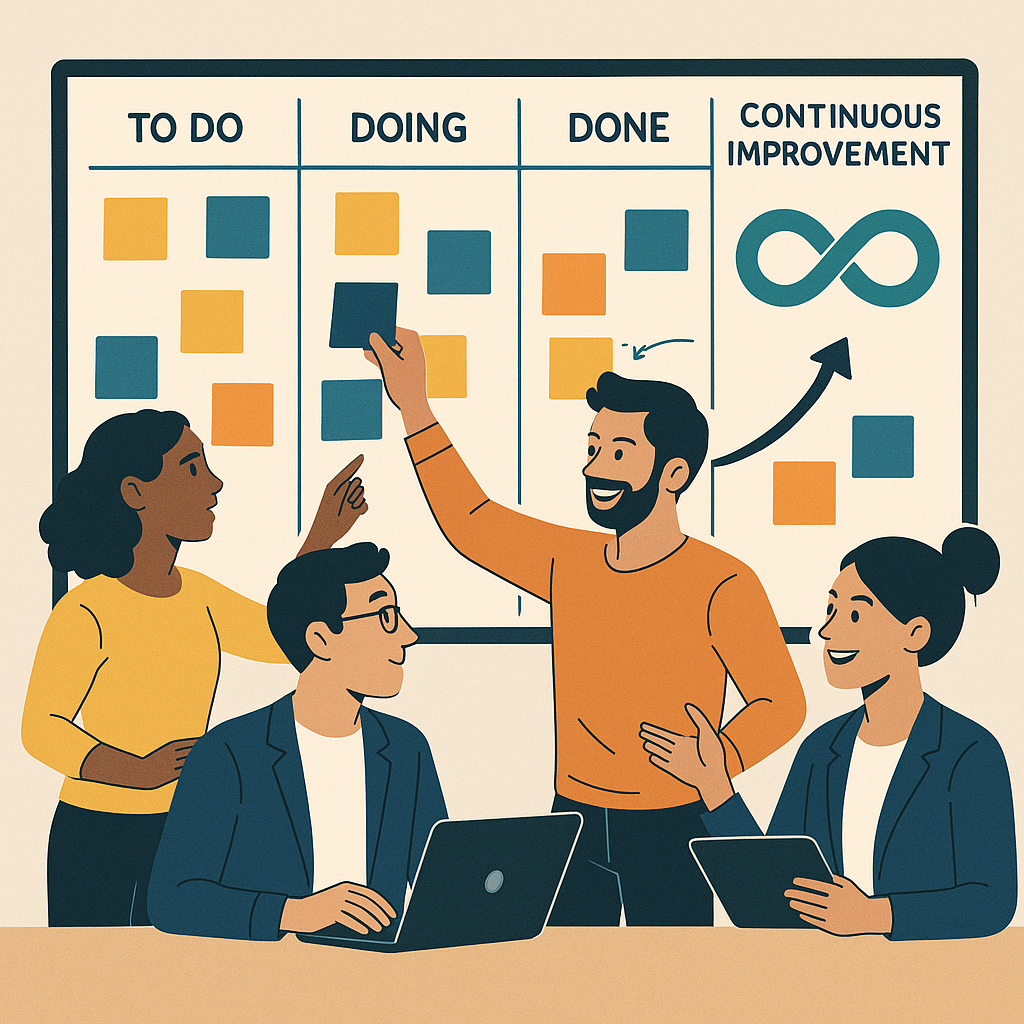
A practical guide to Lean-Agile principles tailored for enterprise leaders driving SAFe-scale transformation.
Why Lean-Agile principles matter to executives
Most large organizations say they want to be "Lean" and "Agile," but translating those words into daily leadership behavior is where transformations stall. Teams attend Scrum or SAFe training, tools are rolled out, backlogs are created—yet strategy, governance, and funding still operate on annual cycles, decisions are centralized, and work is overloaded. For executives in healthcare, financial services, or technology, the question is no longer whether Lean‑Agile is relevant; it is how to apply its principles in a way that genuinely improves predictability, time‑to‑market, and business outcomes.
At their core, Lean and Agile principles are economic. SAFe’s Lean‑Agile principles, outlined at SAFe Lean‑Agile Principles, start with taking an economic view: decisions should be made in the context of cost of delay, risk, and total system throughput, not just local budget or utilization targets. Likewise, Lean software development summarizes its philosophy in seven principles—eliminate waste, amplify learning, decide as late as possible, deliver as fast as possible, empower the team, build integrity in, and optimize the whole. For an executive, that means asking different questions: not "how busy are our teams?" but "how long does it take to get from idea to live usage, how predictable is that, and where are we losing time?".
Another crucial mindset shift involves how you think about variability and options. Traditional plans try to eliminate uncertainty up front through detailed requirements and fixed‑scope, date‑driven commitments. Lean‑Agile principles argue for preserving options and assuming variability, then converging based on data. The SAFe article on the Lean‑Agile mindset at Lean‑Agile Mindset explains why building incrementally with fast, integrated learning cycles reduces both delivery and compliance risk in complex enterprises. External guides like Atlassian’s comparison of Lean vs. Agile and Apptio’s overview of Lean‑Agile principles provide additional language you can use with finance, operations, and technology peers.
Finally, connect these principles directly to your business context. In regulated healthcare or financial services, for example, "build quality in" means designing compliance and auditability into your definition of done instead of relying on late‑stage review boards. "Organize around value" means mapping your value streams—claims, onboarding, EMR workflows—and forming stable, cross‑functional teams around them. As you do, resist the temptation to copy frameworks mechanically. Use Lean‑Agile principles as constraints and guide rails, then design an operating model that fits your culture, technology stack, and maturity level. The goal is not to "install SAFe" but to create a system where strategy and delivery are aligned, teams are empowered, and outcomes become more predictable over time.
Key Lean and Agile principles every executive must internalize
For leaders in large enterprises, Lean and Agile can feel like competing buzzwords rather than a coherent way of running the business. In reality, they complement each other. Lean asks you to eliminate waste, optimize flow, and focus relentlessly on value; Agile asks you to embrace change, deliver iteratively, and empower cross‑functional teams. Together they form the foundation of modern frameworks like SAFe, but the real leverage point is not at the team level—it is in how you, as an executive, think and decide.
Start by internalizing a few core Lean ideas in your context. First, value is defined by your customers and stakeholders, not by internal activity. A quarterly planning deck, a steering committee, or a new workflow in Jira has no value unless it shortens the time to real outcomes such as faster regulatory approvals, higher NPS, or improved EBITDA. Resources like the Planview overview of Lean development at Planview Lean Development offer a concise translation of manufacturing‑born Lean principles into knowledge work.
Second, flow beats utilization. Traditional governance optimizes for keeping people and budgets fully allocated; Lean leadership optimizes for reducing lead time from idea to impact. SAFe’s Lean‑Agile principles at SAFe Lean‑Agile Principles put this explicitly: take an economic view, apply systems thinking, and make value flow without interruptions. This means limiting work‑in‑progress across portfolios, shortening feedback loops, and making dependencies and queues visible so you can remove systemic blockers instead of pushing teams harder.
Third, agility is rooted in mindset, not ceremonies. The Lean‑Agile mindset described at Lean‑Agile Mindset combines Lean thinking with the Agile Manifesto. For leadership, this translates into behaviors: welcoming changing requirements when economics justify it, funding value streams over projects, and insisting on objective proof in working systems before escalating investment. When executives cling to fixed‑scope, date‑driven commitments disconnected from capacity and variability, teams are forced into performative agile—story points and stand‑ups without real adaptability.
Finally, respect for people is not a soft add‑on; it is an economic necessity. Overloaded teams, frequent context switching, and command‑and‑control decision making produce burnout, defects, and rework—the most expensive waste in large programs. Lean and Agile both assert that the best architectures and solutions emerge from empowered, self‑organizing teams operating in psychologically safe environments. As a leader, how you respond to bad news, missed objectives, or raised risks is a daily test of whether you truly respect people and see them as the system’s problem‑solvers, not its problem.
Practical experiments to embed lean-agile behaviors
Translating principles into behavior requires structured experimentation, not another slide deck. One powerful pattern is to treat leadership changes as time‑boxed experiments with clear hypotheses and measures. For example, if you want to reduce portfolio overload, you might run a 90‑day experiment limiting WIP at the epic level for two key value streams. Your hypothesis: by capping new starts and enforcing explicit entry policies, average flow time from approval to release will fall by 20%, and predictability of commitments will improve. You can anchor your design of experiments in Lean software guidance like the seven principles summarized at Lean Software Development and practical examples from Agile Velocity at Agile Velocity Lean Principles.
Design a small number of leadership‑owned experiments around four levers: funding, governance, measurement, and structure. On funding, pilot lean budgeting for one product line—allocate a fixed capacity budget to a long‑lived value stream instead of project by project. On governance, replace phase‑gate reviews with frequent, objective check‑ins on working solutions, using the Agile Alliance’s 12 principles at Agile Manifesto Principles as a lens for healthier milestones. On measurement, shift a portion of your dashboard from activity metrics (hours burned, stories completed) to flow and outcome metrics (flow time, change failure rate, business value delivered). On structure, pilot forming one or two true cross‑functional, value‑aligned teams or Agile Release Trains around critical journeys instead of functional silos.
Equally important is how you communicate and model these changes. Enterprise Lean‑Agile transformations stall when leaders delegate mindset change to coaches while retaining traditional behaviors themselves. The agile leadership principles from sources like ICAgile at ICAgile Agile Leadership and the Agile Business Consortium’s nine principles at Nine Principles of Agile Leadership emphasize leading by example, soliciting feedback, and devolving appropriate authority. Make your own working agreements visible: how quickly will you decide, what decisions will you push down, and how will you respond when experiments do not hit their targets? When leaders show they are willing to change how they think and act—not just what they ask others to do—the Lean‑Agile system has a chance to take root.